

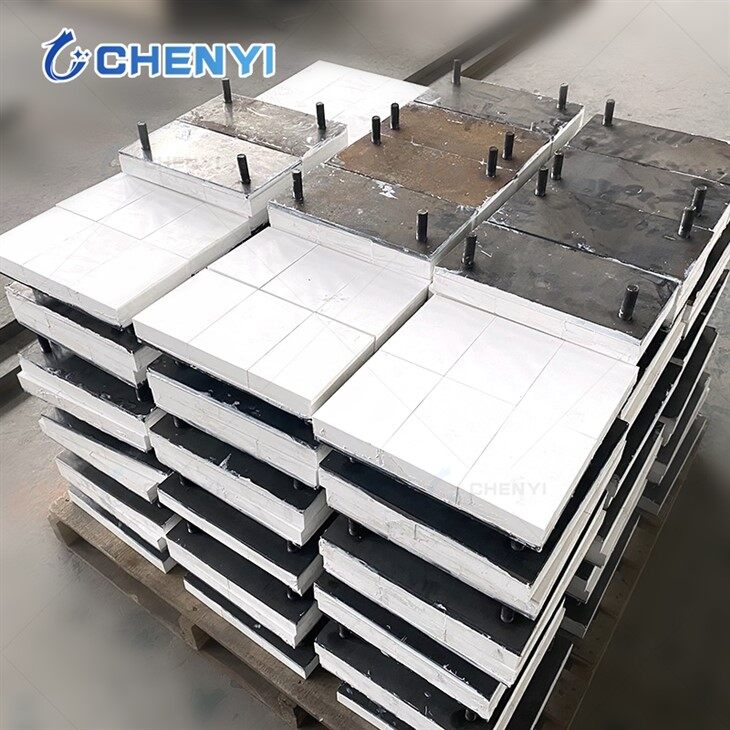


Zibo Chenyi Advanced Materials Co., Ltd. is one of the leading manufacturers and suppliers of steel wear liners with ceramic wear face in China, also supports customized service. If you're going to buy CE approved steel wear liners with ceramic wear face made in China, welcome to get quotation from our factory. Quality products and low price are available.
Wear&corrosion Resistant Steel Wear Liners with Ceramic Wear Face
Structure Declaration
Surface layer: High-hardness wear-resistant ceramic (alumina Al₂O₃ / silicon carbide SiC / ZTA zirconia toughening ceramic)
Substrate: Steel plate (Q235, NM450/NM500 wear-resistant steel, stainless steel, etc.)
structure :
Ceramic direct welding fixed to steel plate
Or adhesive bonding with high-strength wear-resistant adhesive
Embedded, dovetail groove, or bolted compression structures may also be employed.

Common Types and Structures of Steel Wear Liners with Ceramic Wear Face
|
Type |
Design feature |
Typical Applications |
|
Three-in-one composite liner |
The thermal vulcanization process is employed to vulcanize toughened ceramic tiles between wear-resistant rubber and steel plates. The rubber layer serves to cushion impacts, absorb noise, and protect the ceramics from fragmentation. |
High-impact and high-wear areas, such as chutes and feed boxes in industries like mining and iron ore processing. |
|
Bonded ceramic liner |
Apply high-strength organic or inorganic adhesives (with a temperature resistance up to 350°C) to bond the ceramic sheet to the bolted steel groove. |
Large-scale material conveying equipment, suitable for high-temperature or impact-prone operating conditions. |
|
Metal Matrix Ceramic Composite Liner Plate |
The ceramic blocks are embedded in the cast metal matrix, with only the wear-resistant surface of the ceramic exposed. The metal matrix protects the ceramic sides and provides overall strength. |
Moderate to high impact operating conditions, such as chute and deflector plates. |
|
Alumina ceramic-lined pipeline |
High-purity alumina ceramic is installed as an inner lining inside the steel pipe to form a wear-resistant layer. |
High-wear powder, slurry, and ash residue conveying pipelines, such as those used in power plants, cement plants, and mining industries. |
Core advantage of Steel Wear Liners with Ceramic Wear Face
Compared with traditional metal wear-resistant plates, ceramic-clad wear-resistant steel plates exhibit significant advantages:
Exceptionally long service life: The core advantage lies in its outstanding wear resistance. Alumina ceramics typically exhibit hardness exceeding 1440 HV. In practical applications, their service life is 3 to 10 times longer than conventional wear-resistant steel plates. For instance, cases demonstrate that steel rubber liners previously requiring replacement every 4 months achieved 18 months of trouble-free operation after being replaced with ceramic liners. At another nickel ore processing plant, the new ceramic composite liners maintained normal operation for 319 days under extreme conditions, whereas the previous liners had an average lifespan of less than 3 weeks.
Reduction of downtime and maintenance costs: Longer service life significantly decreases replacement frequency, effectively reducing unplanned downtime caused by equipment repairs. Although initial procurement costs may be higher, the overall cost of ownership (OBO) is lower over the entire equipment lifecycle due to enhanced durability.
Excellence in impact resistance and noise reduction capabilities: Particularly the "three-in-one" composite structure, where the intermediate rubber layer effectively cushions the substantial impact forces of materials, prevents ceramic fragmentation, and significantly reduces operational noise levels, thereby improving the working environment.
Prevention of material adhesion: The smooth ceramic surface with low friction coefficient helps prevent the accumulation of moist or adhesive materials on the liner surface, ensuring smooth material flow.
Applications of Wear-resistant Metal Ceramic Liner
Mining: Protects machinery like crushers, mills, and chutes that deal with heavy abrasion from ores and rocks.
Cement Plants: Used in hoppers, mills, and kilns where abrasion is common due to the movement of materials like cement clinker.
Steel and Foundry: Protects equipment that deals with molten metals and other high-temperature materials.
Power Generation: Used in coal-handling systems to reduce wear on conveyors and hoppers.
Advantages
Wear resistance: Ceramics far surpass metals. Traditional metal linings such as AR steel plates, although exhibiting higher hardness than ordinary steel plates, still cannot match the performance of ceramics.
Impact resistance: Metals perform better. The brittleness of ceramics is their primary weakness, posing a risk of fracture under severe impact. Therefore, in high-impact applications, it is recommended to prioritize "three-in-one" composite liners with a rubber cushioning layer.
Corrosion resistance: Ceramics exhibit superior performance. Ceramics demonstrate strong resistance to chemical substances such as acids, alkalis, and salts, whereas common metals are prone to corrosion.
Heat resistance: Ceramics generally exhibit superior performance. Many ceramics maintain high hardness at elevated temperatures, whereas metals tend to soften under high temperatures.
Installation and Maintenance: Metal provides greater convenience. Metal liners can be directly welded or bolted, facilitating on-site processing and repairs. Ceramic liners require relatively complex installation procedures and necessitate specialized solutions, with limited repairability after damage.
Cost: The initial investment for ceramic liners is typically high, but their long service life makes them more economical over the entire lifecycle.
FAQ
Q: What is the minimum order quantity?
A: Standard-sized products require a minimum order of 100 pieces; custom orders have flexible minimum quantities. Volume purchases (≥500 pieces) qualify for preferential pricing.
Q: What is the service life in mining applications?
A: 3-5 years in coal handling applications; 1-2 years in gold/iron ore (high quartz content) applications – 6-10 times longer than manganese steel liners.
Q: Are installation accessories provided?
A: We supply matching adhesives, bolts, and welding rods, accompanied by installation manuals and video tutorials; on-site technical support is available for large-scale projects.
Q: Does the product comply with international standards?
A: Complies with ASTM, DIN, and ISO standards. Material and performance certified by SGS. Customisable to regional requirements.
Q: How are liner replacements or damage handled?
A: Manufacturing defects covered within the warranty period. We offer wear-and-tear replacements at preferential pricing with expedited delivery to minimise downtime.
Contact Person: Sabrina Sun
Email:sabrina@zbchenyi.com whatsapp/wechat:+8618369949806


