

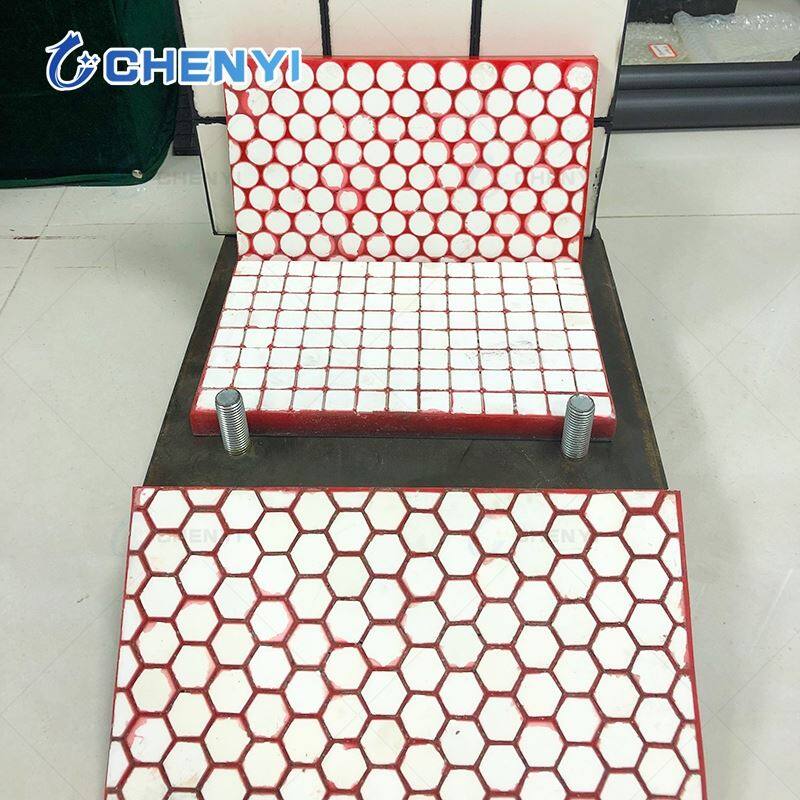


Zibo Chenyi Advanced Materials Co., Ltd. is one of the leading manufacturers and suppliers of polyurethane ceramic wear liner in China, also supports customized service. If you're going to buy CE approved polyurethane ceramic wear liner made in China, welcome to get quotation from our factory. Quality products and low price are available.
Manufacturer of Polyurethane Ceramic Wear Liner from China

Polyurethane Ceramic Wear Liner Structure
Surface: ceramic tiles/columns (commonly rectangular, hexagonal, or cylindrical, arranged in a dense grid)
Intermediate layer: Polyurethane elastomer (10–20 mm thick, hydrolysis/abrasion-resistant formulation)
Under layer (optional): carbon steel backplate + welded bolts for quick fixation
Preparation Process
Ceramic preform: sintered alumina/silicon carbide ceramic sheets, precision machining to ensure dimensional accuracy;
Polyurethane formulation: Select hydrolysis-resistant, high-toughness PU elastomers (e.g., PTMG type);
Mold composite: ceramic embedded in mold, polyurethane cast, high-temperature vulcanization/cross-linking;
Steel-reinforced composite (if required): The composite layer is subjected to secondary sulfidation with bolted steel plates.
Quality inspection: measure the bonding strength, hardness, and dimensional tolerances.
Core Performance Parameters and Features
|
function |
representative value |
Advantages |
|
ceramic hardness |
Mohs 9 (alumina)/9.5 (SiC) |
significantly higher than wear-resistant steel and rubber |
|
applicable temperature |
-30℃~80℃ (standard PU); 100℃ (high-temperature resistant PU) |
Prevent PU softening caused by overheating |
|
wearing life |
10–20 times that of manganese steel and 5–8 times that of pure rubber |
Significant extension of cycle time for mine / cement working condition |
|
resistance to impact |
Absorb over 80% of the impact energy to prevent ceramic fragmentation |
superior to pure ceramic and hard alloy |
|
dielectric |
acid/alkali resistant salts, pulp, wastewater; not resistant to strong polar solvents |
Applicable to Chemical Industry / Hydrometallurgy |
Application
Mine / Coal: silos, chutes, vibrating screens, cyclones, pipe elbows;
Cement / Building Materials: Raw Material / Fired Material Chutes, Hoist Hoppers, Mill Linings;
Metallurgy: blast furnace slag ditch, ore pulp conveying pipeline, flotation tank;
Power: coal transport corridor for thermal power plant, desulfurization slurry pipeline;
Water treatment: Sewage pumps, inlet and outlet pipelines of sedimentation tanks.
Features
Balancing rigidity and flexibility: Ceramic wear resistance paired with PU cushioning, effectively addressing the brittleness issue of pure ceramics.
Low-noise operation: The PU layer effectively reduces vibration and noise, creating a more comfortable working environment.
Flexible installation: Adhesive or bolted mounting; compatible with curved pipes, chute, and other irregular surfaces.
Low maintenance cost: long service life and less replacement frequency.
Model Selection and Limitation
Ceramic selection: alumina is cost-effective and suitable for general wear; RBSC (reactive sintered silicon carbide) is harder and more corrosion-resistant, ideal for high-abrasion and acidic slurries.
Temperature limit: Long-term use above 100℃ is strictly prohibited, as it may cause polyurethane to degrade and soften. For high-temperature applications, pure ceramic or metal-ceramic materials are recommended.
Installation method: For locations with significant vibration and strong impact, fixation must be achieved using steel backing plates and bolts; static surfaces can be adhered with specialized adhesive.
Cost comparison: higher than pure rubber and wear-resistant steel, but significantly lower than pure SiC ceramic, offering exceptional cost-effectiveness.
VI. Differences from Rubber-Ceramic Liners
Polyurethane (PU) is more resistant to oil, hydrolysis, and aging than natural rubber.
Under the same hardness, PU exhibits superior rebound and tear resistance compared to conventional rubber.
The price is slightly higher than rubber ceramic liners, but the service life is generally improved by 30%–50%.
|
Operating condition level (temperature / abrasion / impact / medium) |
Recommended ceramic type |
Polyurethane layer formulation / thickness |
integral structure of liner |
Recommended thickness (ceramic + PU) |
way to install |
Adapt to typical scenarios |
|
Conventional operating conditions: ≤60°C, low-to-medium abrasion, micro-impact (≤5J), neutral medium (water/dry material/standard pulp) |
92% alumina ceramic (hexagonal/rectangular flakes) |
Standard hydrolysis-resistant PU 8-10mm |
Ceramic + PU double layer |
15-20mm (ceramic 6-8mm + PU 9-12mm) |
high strength wear resistant adhesive |
Cement raw material chute, coal conveying corridor of thermal power plant, inner wall of dry material silo, low flow rate clean water pipeline |
|
Moderate abrasion conditions: ≤70°C; moderate to high abrasion with low impact (5-10J); weakly acidic or alkaline media (pH 4-10) |
95% high-alumina ceramic (cylindrical ceramic column) |
Acid and alkali resistant PU 10-12mm |
Ceramic + PU double layer |
20-25mm (ceramic 8-10mm + PU 12-15mm) |
Paste + Local Strip |
clinker chute, medium speed pulp pipeline in mine, inner wall of flotation tank, discharge port of vibrating screen |
|
Strong abrasion condition ≤80°C, strong abrasion (including quartz sand/iron ore), impact (10-20J), weak corrosion pulp |
RBSC reaction sintered silicon carbide ceramics (square dense sheets) |
High-strength hydrolysis-resistant PU 12-15mm |
Ceramic + PU + Steel back (3-4mm steel backing) |
25-30mm (ceramic 10mm + PU 12-15mm + steel backing 3mm) |
Bolt fixation (with countersunk bolts) |
High-flow slurry elbow, inlet and outlet of hydrocyclone, lower section of blast furnace slag ditch, and flow section of slurry pump |
|
Low and Medium Erosion and Micro Impact Neutral/Weakly Alkaline Medium in Conventional 60-100℃ High Temperature Conditions |
92% alumina ceramic (high-temperature resistant ceramic tile) |
Heat-resistant PU formulation, 8-10mm |
Ceramic + PU double layer |
15-20mm (ceramic 6-8mm + PU 9-12mm) |
high temperature resistant adhesive bonding |
Tailrace chute of cement kiln, hot charge conveying pipeline (≤100℃), desulfurization low-temperature slurry pipeline of power plant |
|
High Impact Condition ≤70°C Medium Erosion High Impact (20-30J) Neutral Coarse Particle Material |
95% high-alumina ceramic (thick sheet + lattice arrangement) |
Ultra-high-strength polyurethane PU15-20mm |
Ceramic + PU + Steel Back (4-5mm thickened steel backing) |
30-35mm (ceramic 10mm + PU 15-20mm + steel backing 4mm) |
Bolt + welded pressure plate dual fixation |
heavy-duty ore hopper, crusher discharge, belt conveyor drop point, coarse ore chute |
|
Special corrosion-resistant conditions: medium abrasion, low-impact, strong acid/alkali media (pH 1-3/11-14) at ≤80°C |
SiC (Silicon Carbide) ceramic, corrosion-resistant and dense sheets |
Highly acid-alkali resistant PU formulation, 10-12mm |
Ceramic + PU + Steel Back Three-Layer |
20-25mm (ceramic 8mm + PU 12-15mm + steel backing 3mm) |
Bolt fixation (corrosion-resistant coated bolts) |
Chemical pickling pulp pipeline, hydrometallurgical acid-base tank, desulfurization strong alkaline slurry pipeline |
Core Selection Supplementary Rules (Applicable to All Operating Conditions)
Ceramic tile arrangement: for impact conditions, a sparse grid pattern is selected (with large PU buffer space); for abrasion conditions, a seamless dense arrangement is chosen (eliminating abrasive dead zones).
Key points for PU layer: Do not use ordinary PU above 80°C; prioritize pure ceramic liners or metal-ceramic materials to prevent PU softening and aging.
Steel back material: The steel back under corrosive conditions shall undergo hot-dip galvanizing or spray coating treatment, with a minimum thickness of 3mm to ensure rigidity.
Thickness rule: For areas prone to wear such as pipe elbows and flange corners, add 5-10mm to the base thickness.
Contraindications: When operating at temperatures exceeding 100°C, in strong oxidizing media (e.g., concentrated nitric acid/chlorine gas), or with strong polar solvents (e.g., acetone/methanol), the PU will degrade rapidly. In such cases, pure RBSC/SiC ceramic liners are recommended.
Acceptance criteria (for direct supplier connection)
The bonding strength of ceramic and PU is ≥3MPa, and the ceramic does not fall off or crack under normal temperature.
The ceramic surface is free of cracks and pores, with alumina ceramics exhibiting a hardness of ≥HV1200 and RBSC silicon carbide achieving ≥HV2400.
The PU layer shows no bubbles or shrinkage cavities, and no deformation or delamination after high-low temperature cycling tests (-30℃/80℃,2-hour cycle).
The positioning error of the steel back bolt hole is ≤±0.5mm, and the flatness of the integral liner is ≤1mm/m.


Contact Us
Zibo Chenyi Advanced Materials Co., Ltd is a factory specializing in the production of composite rubber ceramic wear liners, which have been sold to many countries such as Australia, Canada, Russia, Kazakhstan and so on, and are trusted by our customers.
Our ceramic wear-resistant linings are available in a variety of sizes and structures, which can be customized according to the different needs of customers to meet the requirements of various working conditions.
Contact us for a quote or customization information.
E-mail:sabrina@zbchenyi.com
Tel/WhatsAPP:+86 18369949806


