


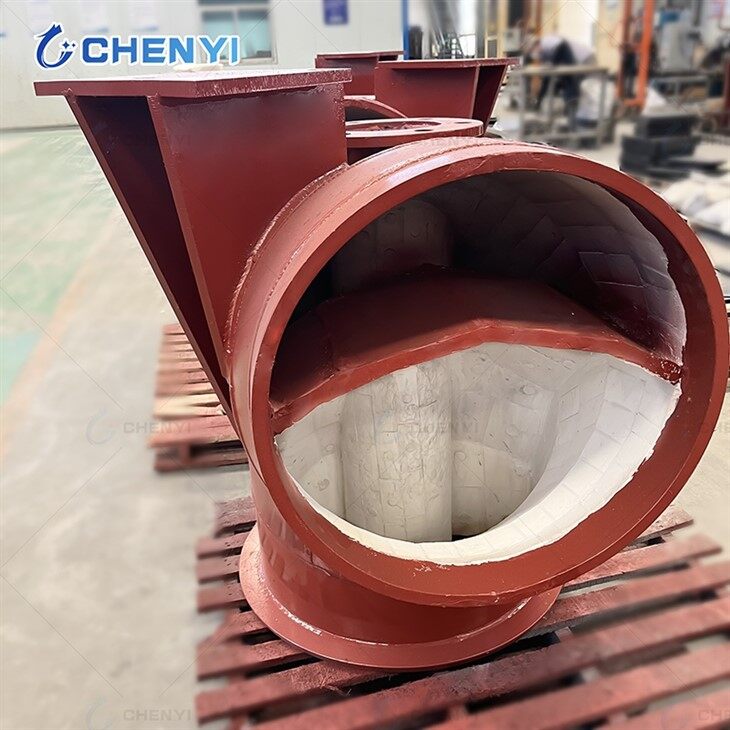


Zibo Chenyi Advanced Materials Co., Ltd. is one of the leading manufacturers and suppliers of ceramic lined y-pieces in China, also supports customized service. If you're going to buy CE approved ceramic lined y-pieces made in China, welcome to get quotation from our factory. Quality products and low price are available.
Large Diameter Alumina Ceramic Lined Y-Pieces for Mining Coal Industry

Structural composition: usually composed of ceramic(alumina or silicon carbide) layers, transition layers, and steel layers. The ceramic layer is located inside and directly in contact with the conveyed medium; The transition layer is used to connect the ceramic layer and the steel layer, playing a role in buffering and enhancing the bonding force; The steel layer provides the strength and toughness of the pipe fittings, ensuring the overall structural stability of the pipe fittings.
Ceramic Lined Y-Pieces Key Features & Benefits
| Feature | Advantage |
| Abrasion Resistance | Alumina (Al₂O₃),Silicon carbide(SISIC or RBSC) or Zirconia (ZrO₂) linings extend lifespan 10–20x vs.bare steel. |
| Impact Resistance | Engineered for high-velocity particle collisions. |
| Corrosion Resistance | Inert ceramics resist acids, alkalis, and oxidation. |
| Smooth Flow Transition | Reduces turbulence and wear hotspots. |
| Custom Geometry | Designed for 30°, 45°, 60°, or 90° branch angles. |
Ceramic Lined Y-Pieces Technical Specifications
| Component Material Options | Base Pipe Carbon steel, Stainless steel (304/316), or Alloy steel. |
| Ceramic Lining | 92% Al₂O₃ (standard), 95% Al₂O₃ (premium), ZTA/ZrO₂/SiC (extreme wear). |
| Bonding Method | Vulcanized rubber-backed tiles, sintered ceramics, or epoxy adhesives. |
| Parameter | Value |
| Ceramic Thickness | 5–20 mm (customizable). |
| Hardness | (Mohs) 9 (Al₂O₃), 9.5 (SiC). |
| Max. Temp. | 400°C (rubber-backed), 800°C (sintered). |
| Pressure Rating | Up to 25 bar (higher on request). |
| Size Range | 2" to 36" (DN50–DN900). |
The Problem: Why Y-Pieces are a Critical Wear Point
In any piping system, changes in flow direction are areas of intense wear. A Y-piece is particularly vulnerable for several reasons:
Direct Impingement: The main flow stream slams directly into the "branch point" or "splitting lip." This area suffers from continuous, high-velocity impact.
Turbulence: The sudden division of flow creates significant turbulence and vortices, which grind away at the interior walls.
Angle of Attack: Abrasive particles strike the walls at acute angles, which is a highly effective cutting and gouging action.
Concentrated Wear: Unlike straight pipes with uniform wear, wear in a Y-piece is highly localized and severe. An unprotected steel Y-piece can wear through in a matter of weeks or even days.
The Solution: Ceramic Lining Configurations
1. Rubber-Backed Alumina Tiles (The Gold Standard for Slurry)
This is the direct application of the composite material discussed previously.
How it works: Flexible sheets of rubber with hexagonal or rectangular alumina tiles vulcanized to them are installed inside the Y-piece.
Advantages:
Superior Impact Absorption: The rubber backing is critical for handling the constant, high-energy impacts at the branch point.
Perfect Conformity: The flexible sheets can be carefully cut and fitted to the complex geometry of the Y-piece, including the critical splitting lip.
Seamless Protection: When installed correctly, it forms a continuous, gap-free protective layer.
Best for: Severe service with a mix of large-particle impact and fine-particle abrasion (e.g., mill discharge, hydrocyclone feed, tailings).
2. Direct Bonded Ceramic Tiles (for High Temperature or Pure Abrasion)
How it works: Individual alumina tiles are directly bonded to the steel shell using high-temperature epoxy or inorganic adhesives.
Advantages:
Can handle higher temperatures than rubber-backed systems.
Very high surface hardness.
Disadvantages:
More vulnerable to impact damage on the splitting lip due to the lack of a resilient backing.
Installation is more labor-intensive and requires very precise fitting.
3. Self-Fluxing Alloy Welded Ceramic Tiles (The Ultimate Solution)
How it works: Alumina tiles with special metal backing are brazed/welded onto the steel shell using a self-fluxing nickel-based alloy in a high-temperature furnace.
Advantages:
Extremely Strong Bond: The metallurgical bond is far stronger than any adhesive, making it ideal for extremely high-impact environments.
Excellent Thermal Conductivity: Dissipates heat effectively.
Can Withstand Very High Temperatures.
Disadvantages:
Very High Cost.
Requires specialized furnace facilities and processes.
Best for: The most extreme applications where other methods fail, or in high-temperature processes beyond the limits of rubber or epoxy.
4. Isostatically Pressed Ceramic Liners (for Simpler Geometries)
How it works: The entire Y-piece is made from or lined with a precision-engineered alumina ceramic cylinder that is formed isostatically.
Advantages:
Perfectly smooth, seamless bore with no gaps.
Exceptional purity and density, leading to superb wear resistance.
Disadvantages:
Very brittle and vulnerable to thermal shock and mechanical impact.
Extremely difficult and expensive to manufacture for a complex shape like a Y-piece. More common for straight pipes and simple elbows.
Design Considerations
Branch Angle: 30°–90° (affects wear pattern).
Flow Velocity: >3 m/s requires thicker ceramics.
Installation: Flanged or welded connections; ensure proper alignment.
Manufacturing process
Self propagating high-temperature synthesis (SHS): Utilizing the exothermic reaction between metal oxides and raw materials such as aluminum powder, high temperatures are generated instantly, causing the reaction products to melt and form a ceramic layer on the inner wall of the steel pipe. If the reaction Fe ₂ O3+2Al=2Fe+Al ₂ O3, under the action of centrifugal force, the generated molten alumina is uniformly spread on the inner wall of the steel pipe, and then cooled and solidified to form a ceramic layer.
Isostatic pressure forming method: ceramic powder is loaded into a mold, compacted and formed under high pressure, and then subjected to high-temperature sintering and other processes to produce ceramic lined pipe fittings. This method can make the density of ceramic lining uniform and the performance stable.
Service
* Provide 7 * 24-hour service. Feel free to contact us by phone, email, instant messaging and social media.
* After receiving your inquiry, reply within 8 hours, and provide the price plan within 24 hours.
* Review and monitor project details and progress at no cost by a professional team of sales, engineers
and QC personnel.
* In the cost, production, inspection, packaging, delivery and other aspects to provide a full range of intimate services.
* Provides professional support and assurance at all stages of sales.
FAQ
Contact information:Sabrina Sun +8618369949806
Email:sabrina@zbchenyi.com


