

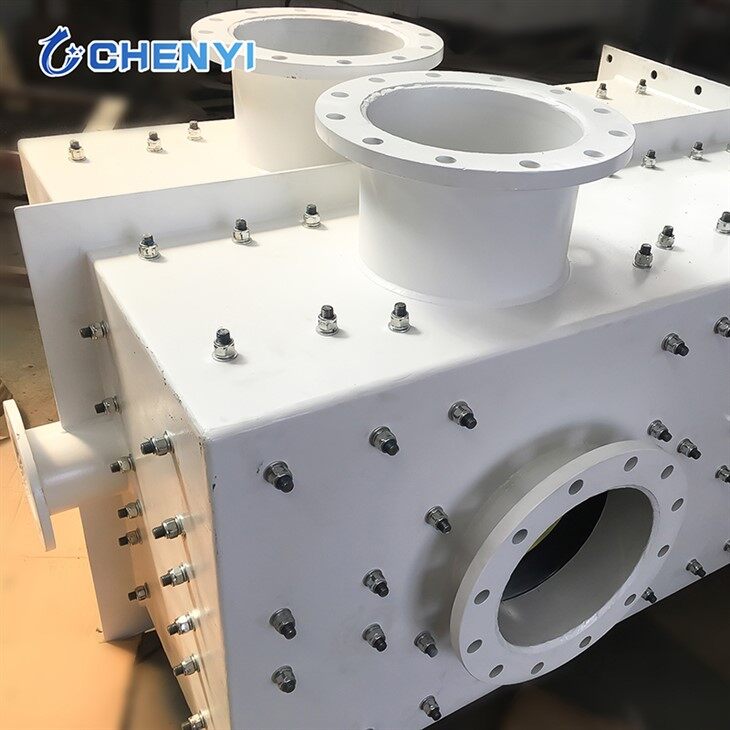


Zibo Chenyi Advanced Materials Co., Ltd. is one of the leading manufacturers and suppliers of ceramic lined rotary dryer feed chute in China, also supports customized service. If you're going to buy CE approved ceramic lined rotary dryer feed chute made in China, welcome to get quotation from our factory. Quality products and low price are available.
Wear&impact Resistant Ceramic Lined Rotary Dryer Feed Chute

The main challenge of the feeding chute is to deal with material adhesion and blockage, as well as wear caused by high-speed particle flow. When dealing with sticky and wet materials, improper chute design can easily lead to blockage, becoming a bottleneck for the entire production line
| Parameter | Typical Value/Range |
| Steel Shell Material | Carbon steel, Stainless steel, or Alloy steel |
| Ceramic Lining Type | Alumina (Al₂O₃), Zirconia (ZrO₂), Silicon Carbide (SiC),cast basalt |
| Ceramic Thickness | 3–30 mm (varies by application) |
| Bonding Method | Adhesive, Sintered, or Mechanical interlock |
| Operating Temp. | -40°C to +800°C (depends on adhesive/ceramic) |
| Pressure Rating | Up to 100 bar (customizable) |
| Diameter Range | 1" to 48" (25 mm – 1200 mm) |
| Length Custom | (typically 0.5–6 meters) |
| Hardness | (Mohs) 9 (Alumina), 8.5 (Zirconia), 9.5 (SiC) |
| Abrasion Resistance | 10–20x longer life vs. bare steel |
|
Performance Index |
92% |
95% |
|
Al2O3 |
>=92% |
>=95% |
|
Fe2O3 |
<=0.02% |
<=0.02% |
|
Compressive strength(Mpa) |
>=2000 |
>=2250 |
|
Hardness mohs |
>=9 |
>=9 |
|
Volume density(g/cm3) |
>=3.60 |
>=3.70 |
|
Water absorption(%) |
<=0.01 |
<=0.01 |
| Color of product |
white |
white |
Typical Structure of Ceramic Lined Rotary Dryer Feed Chute
Chute Body
Slant/square tube, inclination angle>natural angle of repose of material (usually ≥ 45 °)
Material: Q235, wear-resistant steel plate, stainless steel, lining wear-resistant ceramic/cast stone/stainless steel
Wear Liner
Key flushing areas can be replaced with lining plates to extend their lifespan
Sealing spout
Insert Spout into the drum
Cooperate with labyrinth seal, graphite seal, and gas seal
Anti backflow/diversion structure
Spiral blades (Advancing Flights), conical flow guide, baffle at the entrance
flange connection
Connect with upstream equipment and feeding hood
Key Design Points of Ceramic Lined Rotary Dryer Feed Chute
In order to ensure that materials can enter the dryer smoothly and stably, the design of the chute needs to pay attention to the following aspects:
Adequate tilt angle: This is the key to overcoming the friction between the material and the chute wall. For materials that are sticky, wet, and prone to clumping, the chute needs to be steep enough to utilize gravity to maintain the momentum of the material and prevent it from accumulating on the wall. Practice has proven that a tilt angle of 70 ° is effective for difficult to handle materials.
Low friction coefficient lining: In order to reduce the adhesion and friction of materials on the chute wall, low friction coefficient materials are usually used as lining.
Stainless steel: Using 304 or 316 stainless steel to manufacture the chute can provide a smooth and rust resistant surface. For example, in a certain case, changing the carbon steel chute to 316 stainless steel effectively improved material flow.
Polymer materials, such as ultra-high molecular weight polyethylene (UHMWPE) and other plastic liners, have extremely low friction coefficients and are ideal anti adhesive materials. However, it should be noted that if the chute is close to a heat source (such as the inlet of a dryer), high temperatures may cause deformation or failure of the plastic lining plate, and metal materials must be used in this case.
Avoid complex geometric shapes: Bends or sudden changes inside the chute are high-risk areas for material blockage. Linear design should be adopted as much as possible to eliminate dead corners or steps where materials may accumulate. If turning cannot be avoided, a large radius arc transition is also required.
Measures to deal with wear and tear: For highly abrasive materials such as fly ash, the bottom of the chute and the impact surface will suffer severe wear and tear. In addition to using wear-resistant materials (such as the ceramic lining you mentioned earlier), a replaceable wear-resistant lining plate design can also be used to facilitate maintenance and extend the service life of the chute body.
Simulation analysis and verification: For critical applications, modern design methods use discrete element method to simulate the flow of materials in the chute. This can predict blockage points and wear areas before manufacturing, and optimize the design.
Common problems and improvements
Bridging blockage
Reason: Insufficient angle, wet and sticky material, small cross-section
Improvement: Increase the angle, add a vibrator, liner a smooth skateboard (such as 304/316L), widen the chute
Backstock/Backfilling
Improvement: Extend the insertion section, add a conical baffle, and install a spiral feeding plate at the inlet
Wear out too quickly
Improvement: Thickening the base plate, attaching wear-resistant ceramic tiles, and welding wear-resistant layers
Leakage of air and dust
Improvement: Strengthen sealing (labyrinth+gas seal), soft connection between chute and feeding cover
Common Solutions for Feed Chute Lining
A. Steel Liner
Simple, easy to fabricate and weld.
Suitable for low abrasion, high impact scenarios.
Shorter life when handling highly abrasive material.
B. Ceramic-Lined Steel Chute
Steel backing with ceramic tiles or vulcanized rubber-ceramic tiles.
Advantages:
High wear resistance (5–10× longer than steel)
Impact absorption (if rubber composite used)
Corrosion resistance for chemically aggressive materials
Tile shapes: hexagonal, square, or custom shapes to cover flat or curved surfaces.
Often used for mineral processing, cement, coal, and iron ore applications.
C. Polyurethane Lined Chute
Flexible, high impact resistance.
Can reduce noise and protect against material sticking.
Not as hard as ceramic-better for impact-heavy but less abrasive materials.
Typical Applications
Cement Plants: feeding raw meal or clinker into rotary dryers
Mineral Processing: sand, ore, and coal drying
Fertilizer Industry: drying granular fertilizers
Biomass / Wood Pellets: feeding into high-temperature rotary dryers
Contact us:
Sabrina Sun
Email: sabrina@zbchenyi.com mobile/whatsapp:+8618369949806


